
The first thing that I was quite certain I wanted students to do together both inside and beyond the classroom was to read together. There are many reasons for this. First and foremost, I assign a lot of reading. More reading than I expect a single student to get through. I do this because I want to give students material within which to seek their own interests. I want students to learn how to triage a large amount of text, and to follow their own research questions. This means breaking them of the habit of consuming, processing, and “summarizing” a piece of text. I want every student’s experience of a text to reflect their individual process.
But no matter how many times I explain this, or how early I explain it, or however I try to explain it, students always struggle with the impossibility of reading and understanding everything.
Part of me wonders how much this anxiety reflects an approach to teaching critical reading at the high school level that offers an unrealistic expectation of what it means to understand what a text has to say. But that’s a topic for another time…
I realize that the most obvious thing to do when students clamor for less reading is to give them exactly what they ask for. But, as an instructor, I am bound to ask myself why I want them to read in the first place. And I’m increasingly uncomfortable with the idea of asking students to read something in order to understand it. It seems to me that asking them to read something they can’t possibly absorb whole has so many intellectual and pedagogical benefits (replicating, as it just so happens, many of the processes that comprise the arc of research) that, at the end of the day, their intellectual anxiety is more productive than it is destructive.
That being said, I recognize that it’s cruel. Indeed, it is made even more challenging by the kinds of texts I ask them to read. In my freshman seminar – the first Humanities class that Caltech students take – the entire first three weeks are devoted entirely to reading the Canon of the Han dynasty. Students start off what is sometimes their very first engagement with Chinese history with the entire text and commentaries of the Book of Changes, the Classic of Poetry, and other such hits. These are texts that not only defy the classic “parse-the-author’s-argument-and-biases” approach to reading comprehension (being authorless, non-expository, and written in an entirely unfamiliar register), they are also texts from another cosmological frame.
The struggle is real.
Rather than try to frame their interaction, select a few tiny excerpts that I feel encapsulate “what the Book of Poetry has to offer,” and guide the student’s reading with questions that might result in productive answers that mesh well with my teaching objectives, I took a collaborative approach to reading.
From the very first assignment, I ask students to make groups of two to five (the number and compositions of the groups change over the quarter at various intervals). I ask them to physically be together in a room while they read (or, if that’s impossible, to pick a time to read and share their notes on a collaborative online platform in real time). I ask them to talk while they read. I ask them to pose questions to one another, to record strange or interesting or troubling passages, and to have fun with the texts.
I know that they spend a lot of their time in the first few group reading sessions complaining, or making fun of what seem to be strange and inaccessible texts from another universe. But that’s the magic of reading together. Things happen.
One student told me a funny anecdote: I had asked how his partner from the first class assignment was doing. The two of them had turned in an original, insightful, and entertaining assignment, but his partner had dropped the class that very week. When the subject came up, the student laughed. He said that, while they were working on the first assignment – a reading and note-taking of the Book of Changes (the text of this assignment is reproduced in the previous post), they had found the whole thing ridiculous and impossible to understand.
For those of you who are unfamiliar, the Book of Changes is a series of 64 hexagrams, accompanying verses, and commentary on the import of the verses. An average entry in one of the more challenging typeset and translation editions (they’re given three to work from) looks something like this:
2. Kūn EARTH
xxx xxx Earth
xxx xxx
xxx xxx
xxx xxx Earth
xxx xxx
xxx xxx
kūn. yuán xiǎng. lì pìn mǎ zhī zhēn.
EARTH. MAJOR SACRIFICE. FAVORABLE FEMALE HORSE OF OMEN. EARTH.
Let a MAJOR SACRIFICE be conducted. The OMEN OF the MARE is FAVORABLE.j
ūn zǐ yǒu yōu wǎng. xiān mí, hòu dé zhǔ.
NOBLE PERSON HAVE PURPOSE GO. FIRST LOST, LATER GAIN MASTER.
The NOBLE PERSON PROCEEDS WITH a PURPOSE. You may at FIRST be LOST, but LATER GAIN a MASTER.
lì. xī nán dé péng, dōng běi sàng péng.
FAVORABLE. WEST SOUTH GAIN FRIEND, EAST NORTH LOSE FRIEND. FAVORABLE.
A FRIEND will be GAINED in the SOUTHWEST, a FRIEND will be LOST in the NORTHEAST.
ān zhēn jí.
PEACE OMEN AUSPICIOUS.
The OMEN of PEACE is AUSPICIOUS.
1. lǚ shuāng: jiān bīng zhì.
TREAD FROST: HARD ICE COME.
You are TREADING on FROST: HARD ICE is COMING.
2. zhí fāng dà: bù xí, wú bú lì.
STRAIGHT SQUARE GREAT: NOT REVIEW, NOTHING NOT FAVORABLE.
STRAIGHT, SQUARE, and GREAT: even WITHOUT REVIEW, there is NOTHING that will NOT end FAVORABLY.
3. hán zhāng kě zhēn.
MAINTAIN INTEGRITY CAN DIVINE.
MAINTAIN your INTEGRITY and you CAN engage in DIVINATION.
huò cóng wáng shì. wú chéng yǒu zhōng.
PERHAPS UNDERTAKE KING AFFAIR. NOT ACHIEVE HAVE END.
PERHAPS you will UNDERTAKE SERVICE to the KING. NONACHIEVEMENT will COME to an END.
4. kuò náng. wú jiù wú yù.
DRAW-TIGHT SACK. NO HARM NO PRAISE.
The SACK has been DRAWN TIGHT. NEITHER HARM NOR PRAISE.
5. huáng cháng. yuán jí.
YELLOW GARMENT. MAJOR AUSPICIOUS.
A YELLOW GARMENT. AMAJOR AUSPICIOUS omen.
TOP: lóng zhàn yú yě. qí xuè xuán huáng.
DRAGON BATTLE IN FIELD. THEIR BLOOD BLACK YELLOW.
DRAGONS BATTLE IN the FIELD. THEIR BLOOD flows BLACK and YELLOW.
Appended text:
lì yǒng zhēn.
FAVORABLE ETERNAL OMEN.
The OMEN of ETERNITY is FAVORABLE
So these two students had been working for some time with the text, and just couldn’t find their way into an observation. It all seemed so strange. Jokingly, no doubt while complaining about this annoying class they were taking, one of them suggested to the other that they should use the text. They knew from the lecture that the Book of Changes had previously been used as a divination manual, and I had described briefly how the divination method worked. They grabbed a few coins out of their pockets, and followed the instructions to divine their fates. They both asked whether or not they should continue to take the class.
Each of them rolled, and they went to the appropriate part of the manual in each of the translations to try to divine the answer.
Apparently, the Book of Changes suggested that one of the students should stay in the class. For the other one, the outcome was not so auspicious.
That’s the story of how one of my former students dropped a class after the Book of Changes (and a few coins) told him to.
More importantly, it’s a sample of the kinds of mischief that students get up to when they read together. What can be an insurmountable frustration while reading alone is an opportunity for sharing, for thinking through, and for looking at the text from a new angle when done together.
An instructor might hope to create a moment like this by assigning an activity related to a text, to get students to interact with it in a way that overcomes the reading comprehension straitjacket. But these moments naturally emerge when students are struggling with a text together.
Instead of staring at a blank screen, they complain to one another. They make fun. They marvel at how dumb, or weird, or strange something is. Responses that are roadblocks in the individual reading process become conversation points when a group of peers are all yoked to the same reading exercise.
Sometimes they include the punchier, stranger, and more caustic observations of the group in their submissions (which, early on, I often frame as “data dumps” or “shared notes files.”) But they usually start to draw up from these first-glance reactions from early on.
Outlines emerge. Talking points are embedded in the notes. Quotes fill up the page. Questions float between the lines. Before you know it, something like this exists:
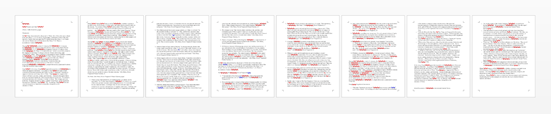
This collaborative reading assignment was created by two individuals in the sixth week of a freshman seminar. It was worth 6% of their total grade (the standard amount of credit that I give in that class for each of the ten weekly assignments)
They start off under the title “Discussion” with summaries of their general impressions of the three assigned readings. These are the high-level takeaway versions of each individual piece.
After the piece-by-piece summary, they delve into a lengthy paragraph summarizing the basic compare-and-contrast scheme into which they’ve grouped the authors. Using a few quotes, they point out how each author approaches the particular subject of that week’s discussion in their essay.
After that high-level summary, their own notes follow. Each section is the author and title of the piece, followed by numbered quotes. The discussion of the quotes (pulling the ‘lesson’ from each out, or summarizing multiple ones) has been placed behind the author name at the top of each section (presumably after discussion).
At the very bottom, their first rough pass at a compare-and-contrast has been sketched out (before being abandoned to make the more high-level summary at the top).
Before you know it, three thousand words of direct quotation, analysis, and summary.
There is never any proscribed format for these assignments. Students are told to do what works, and each group often offers its own take on the assignment. But because the collaborative reading assignment happens under various conditions (students often contribute remotely as well as meeting to discuss the final assignment or the reading), they are compelled to structure the exercise.
Since there is no specific outcome for the final version of the reading assignments (students are told from early on that these will be the material from which they will work on more formal writing exercises), there is an incentive to save work. Editing will happen later. This is the collaborative equivalent of a combination of brainstorming and note-taking.
Students are also warned to be careful not to violate the Caltech Honor Code in their collaboration. Each group must establish expectations about what part of the work belongs to the group, what part belongs to individuals, and what part might be shared with others (especially considering that students will work with multiple groups). This is another problem they tackle differently. Sometimes notes outlines will credit the individual who worked on each section. Sometimes individual notes are taken in addition to group notes and maintained separately.
In the one instance I encountered where two students who had been a part of the same group turned in very similar essays, this collaborative reading assignment turned out to be a useful tool in understanding what had happened. The two students, mortified after I pointed out this similarity to them privately and individually, returned to their group notes. They found where they had discussed their two different ideas in the collaborative documents, looked at their essays, and discussed how they should have tried to distinguish their original work from one another by further developing their ideas in different directions, rather than relying on what had been set forth in the earlier reading iteration of the assignment.
There’s no prescription for what sort of reading should be done individually and what sort should be done together. Or what reading collaboratively should mean in each case. After being required to work in partners for the first few weeks, students are left to determine the size of their own groups (down to a number of one single individual), and are encouraged to experiment with different modes of collaborative reading.
Perhaps when I’m older and wiser I’ll choose to structure these engagements more strictly. But up until now I’ve been so consistently fascinated by the different solutions that students work through on their own terms that I’m encouraged to keep the parameters of these exercises open.
As a field, historians (and perhaps humanists more broadly) have so little experience reading in large groups that we don’t have well-established paradigms and expectations about the products of such engagements. Every group of scholars I’ve read collaboratively with has been an entirely distinct experience that seems to emerge from the “magic” of the combination. Collaborative reading assignments seem like an excellent way to invite students into that realm of discovery, and also to potentially tear through many of the stumbling blocks that might otherwise emerge from reading as individual consumers.

 Jottings from Dreaming Seahorse Studio